Complete phrase guide
All 50 phrases,
situation by situation
Browse the full list below, or download the printable worksheets at the bottom of the page.
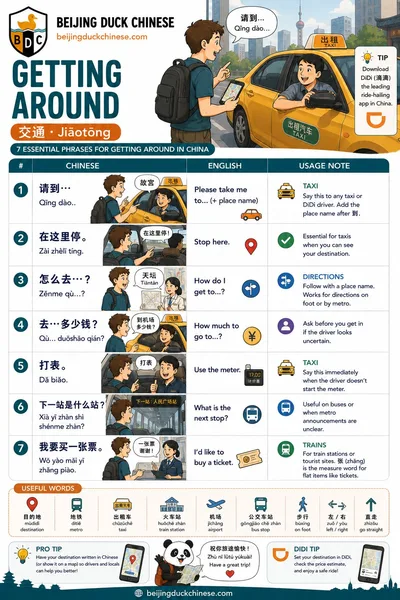
Getting Around
交通 · Jiāotōng
7 phrases
| Chinese | English | Usage note |
|---|---|---|
请到… Qǐng dào… | Please take me to… (+ place name) | Say this to any taxi or DiDi driver. Add the place name after 到.taxi |
在这里停。 Zài zhèlǐ tíng. | Stop here. | Essential for taxis when you can see your destination. |
怎么去…? Zěnme qù…? | How do I get to…? | Follow with a place name. Works for directions on foot or by metro.directions |
去…多少钱? Qù… duōshǎo qián? | How much to go to…? | Ask before you get in if the driver looks uncertain. |
打表。 Dǎ biǎo. | Use the meter. | Say this immediately when the driver doesn't start the meter.taxi |
下一站是什么站? Xià yī zhàn shì shénme zhàn? | What is the next stop? | Useful on buses or when metro announcements are unclear. |
我要买一张票。 Wǒ yào mǎi yī zhāng piào. | I'd like to buy a ticket. | For train stations or tourist sites. 张 (zhāng) is the measure word for flat items like tickets.trains |
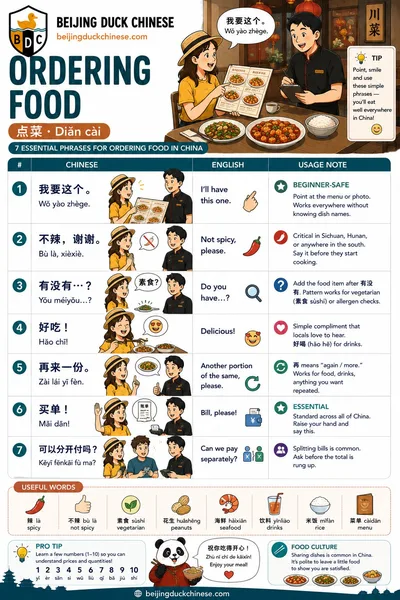
Ordering Food
点菜 · Diǎn cài
7 phrases
| Chinese | English | Usage note |
|---|---|---|
我要这个。 Wǒ yào zhège. | I'll have this one. | Point at the menu or photo. Works everywhere without knowing dish names.beginner-safe |
不辣,谢谢。 Bù là, xièxiè. | Not spicy, please. | Critical in Sichuan, Hunan, or anywhere in the south. Say it before they start cooking. |
有没有…? Yǒu méiyǒu…? | Do you have…? | Add the food item after 有没有. Works for vegetarian (素食 sùshí) or allergen checks. |
好吃! Hǎo chī! | Delicious! | Simple compliment that locals love to hear. 好喝 (hǎo hē) for drinks.social |
再来一份。 Zài lái yī fèn. | Another portion of the same, please. | 再 means "again / more." Works for food, drinks, anything you want repeated. |
买单! Mǎi dān! | Bill, please! | Standard across all of China. Raise your hand and say this.essential |
可以分开付吗? Kěyǐ fēnkāi fù ma? | Can we pay separately? | Splitting bills is common. Ask before the total is rung up. |
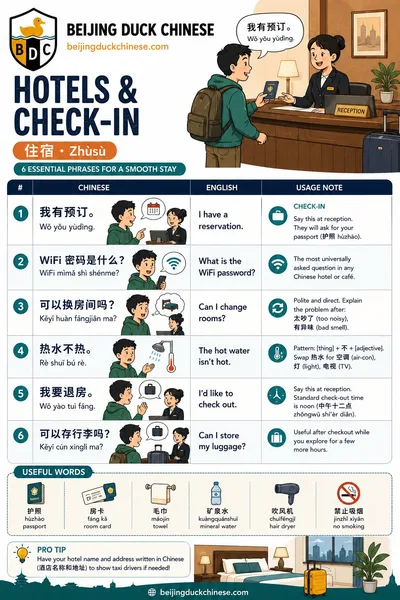
Hotels & Check-in
住宿 · Zhùsù
6 phrases
| Chinese | English | Usage note |
|---|---|---|
我有预订。 Wǒ yǒu yùdìng. | I have a reservation. | Say this at reception. They will ask for your passport (护照 hùzhào).check-in |
WiFi 密码是什么? WiFi mìmǎ shì shénme? | What is the WiFi password? | The most universally asked question in any Chinese hotel or café. |
可以换房间吗? Kěyǐ huàn fángjiān ma? | Can I change rooms? | Polite and direct. Explain the problem after: 太吵了 (too noisy), 有异味 (bad smell). |
热水不热。 Rè shuǐ bú rè. | The hot water isn't hot. | Pattern: [thing] + 不 + [adjective]. Swap 热水 for 空调 (air-con), 灯 (light), 电视 (TV). |
我要退房。 Wǒ yào tuì fáng. | I'd like to check out. | Say this at reception. Standard check-out time is noon (中午十二点 zhōngwǔ shí'èr diǎn). |
可以存行李吗? Kěyǐ cún xíngli ma? | Can I store my luggage? | Useful after checkout while you explore for a few more hours.check-out |
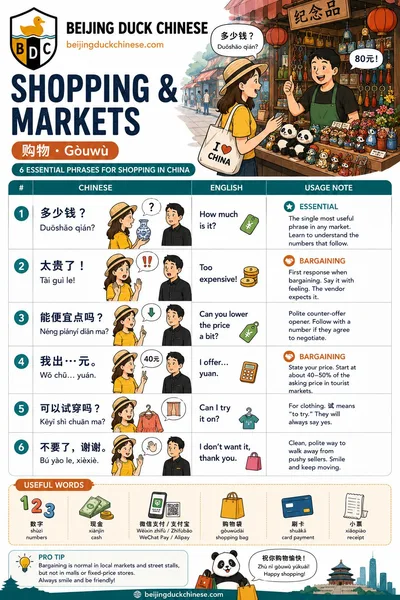
Shopping & Markets
购物 · Gòuwù
6 phrases
| Chinese | English | Usage note |
|---|---|---|
多少钱? Duōshǎo qián? | How much is it? | The single most useful phrase in any market. Learn to understand the numbers that follow.essential |
太贵了! Tài guì le! | Too expensive! | First response when bargaining. Say it with feeling. The vendor expects it.bargaining |
能便宜点吗? Néng piányí diǎn ma? | Can you lower the price a bit? | Polite counter-offer opener. Follow with a number if they agree to negotiate. |
我出…元。 Wǒ chū… yuán. | I offer… yuan. | State your price. Start at about 40–50% of the asking price in tourist markets.bargaining |
可以试穿吗? Kěyǐ shì chuān ma? | Can I try it on? | For clothing. 试 means "to try." They will always say yes. |
不要了,谢谢。 Bú yào le, xièxiè. | I don't want it, thank you. | Clean, polite way to walk away from pushy sellers. Smile and keep moving. |
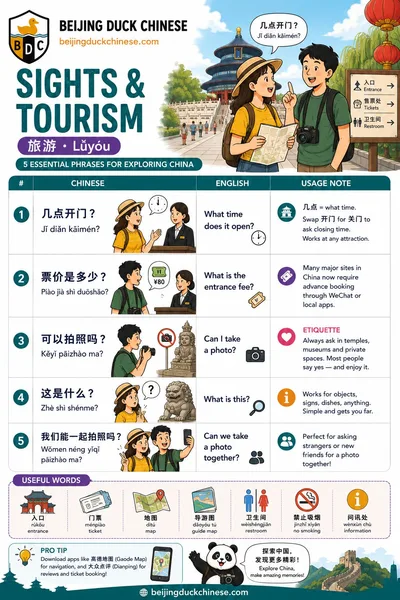
Sights & Tourism
旅游 · Lǚyóu
5 phrases
| Chinese | English | Usage note |
|---|---|---|
几点开门? Jǐ diǎn kāimén? | What time does it open? | 几点 = what time. Swap 开门 for 关门 to ask closing time. Works at any attraction. |
票价是多少? Piào jià shì duōshǎo? | What is the entrance fee? | Many major sites in China now require advance booking through WeChat or local apps. |
可以拍照吗? Kěyǐ pāizhào ma? | Can I take a photo? | Always ask in temples, museums and private spaces. Most people say yes and enjoy it.etiquette |
这是什么? Zhè shì shénme? | What is this? | Works for objects, signs, dishes, anything. Simple and gets you far. |
我们能一起拍照吗? Wǒmen néng yīqǐ pāizhào ma? | Can we take a photo together? | Foreigners asking this in Chinese always gets a great reaction. A guaranteed memory.social |
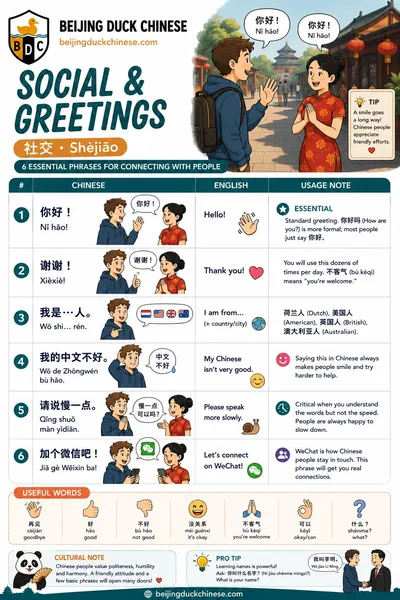
Social & Greetings
社交 · Shèjiāo
6 phrases
| Chinese | English | Usage note |
|---|---|---|
你好! Nǐ hǎo! | Hello! | Standard greeting. 你好吗 (How are you?) is more formal; most people just say 你好.essential |
谢谢! Xièxiè! | Thank you! | You will use this dozens of times per day. 不客气 (bù kèqi) means "you're welcome." |
我是…人。 Wǒ shì… rén. | I am from… (+ country/city) | 荷兰人 (Dutch), 美国人 (American), 英国人 (British), 澳大利亚人 (Australian). |
我的中文不好。 Wǒ de Zhōngwén bù hǎo. | My Chinese isn't very good. | Saying this in Chinese always makes people smile and try harder to help.icebreaker |
请说慢一点。 Qǐng shuō màn yīdiǎn. | Please speak more slowly. | Critical when you understand the words but not the speed. People are always happy to slow down. |
加个微信吧! Jiā gè Wēixìn ba! | Let's connect on WeChat! | WeChat is how Chinese people stay in touch. This phrase will get you real connections.social |
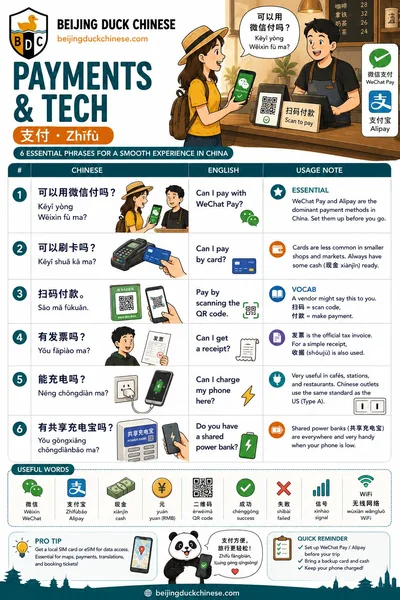
Payments & Tech
支付 · Zhīfù
6 phrases
| Chinese | English | Usage note |
|---|---|---|
可以用微信付吗? Kěyǐ yòng Wēixìn fù ma? | Can I pay with WeChat Pay? | WeChat Pay and Alipay are the dominant payment methods in China. Set them up before you go.essential |
可以刷卡吗? Kěyǐ shuā kǎ ma? | Can I pay by card? | Cards are less common in smaller shops and markets. Always have some cash (现金 xiànjīn) ready. |
扫码付款。 Sǎo mǎ fùkuǎn. | Pay by scanning the QR code. | A vendor might say this to you. 扫码 = scan code, 付款 = make payment.vocab |
有发票吗? Yǒu fāpiào ma? | Can I get a receipt? | 发票 is the official tax invoice. For a simple receipt, 收据 (shōujù) is also used. |
能充电吗? Néng chōngdiàn ma? | Can I charge my phone here? | Very useful in cafés, stations, and restaurants. Chinese outlets use the same standard as the US (Type A). |
有共享充电宝吗? Yǒu gòngxiǎng chōngdiànbǎo ma? | Do you have a shared power bank? | Portable charger rental stations are everywhere in China. Pay via WeChat.china-specific |
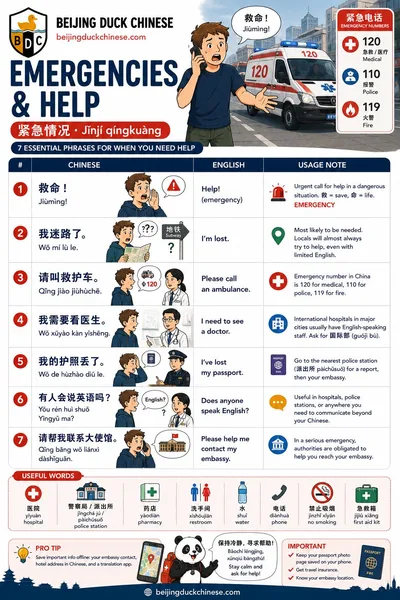
Emergencies & Help
紧急情况 · Jǐnjí qíngkuàng
7 phrases
| Chinese | English | Usage note |
|---|---|---|
救命! Jiùmìng! | Help! (emergency) | Urgent call for help in a dangerous situation. 救 = save, 命 = life.emergency |
我迷路了。 Wǒ mí lù le. | I'm lost. | Most likely to be needed. Locals will almost always try to help, even with limited English. |
请叫救护车。 Qǐng jiào jiùhùchē. | Please call an ambulance. | Emergency numbers in China: 120 for medical, 110 for police, 119 for fire. |
我需要看医生。 Wǒ xūyào kàn yīshēng. | I need to see a doctor. | International hospitals in major cities usually have English-speaking staff. Ask for 国际部 (guójì bù). |
我的护照丢了。 Wǒ de hùzhào diū le. | I've lost my passport. | Go to the nearest police station (派出所 pàichūsuǒ) for a report, then your embassy. |
有人会说英语吗? Yǒu rén huì shuō Yīngyǔ ma? | Does anyone speak English? | Useful in hospitals, police stations, or anywhere you need to communicate beyond your Chinese. |
请帮我联系大使馆。 Qǐng bāng wǒ liánxì dàshǐguǎn. | Please help me contact my embassy. | In a serious emergency, authorities are obligated to help you reach your embassy. |