The street fills up after dark
It's 9pm in Dalian. The street is packed. Cars edge past in both directions, but nobody seems to mind, because between the lanes, plastic tables and tiny pink stools have appeared from nowhere. The smoke rising from the grills smells of cumin and charcoal. Someone thrusts a laminated menu at you. Someone else holds out a QR code.
Welcome to 大排档 (dàpáidàng), the great Chinese outdoor barbecue. And in Dalian, thanks to its coastal location in northeast China, it comes with the freshest seafood you've probably ever eaten.
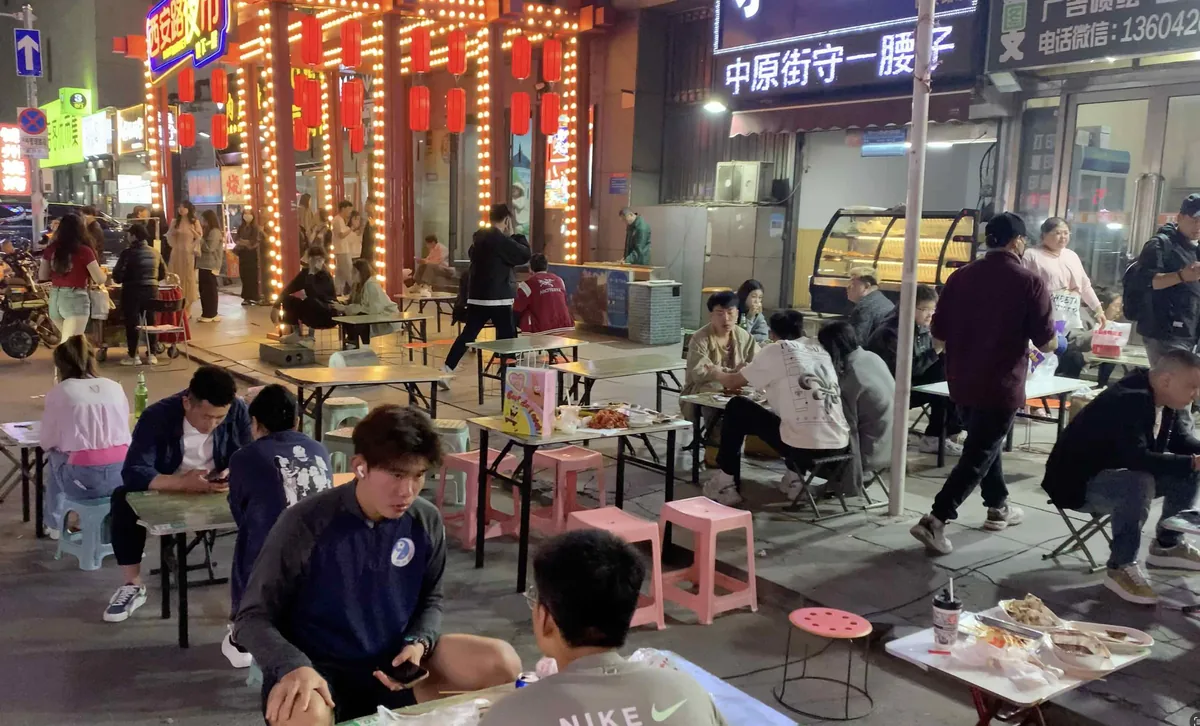
What is a 大排档?
The word 大排档 (dà pái dàng) literally means "big stall row": it originally referred to rows of outdoor food stalls with large wooden boards as counters. Today it means any bustling open-air eating spot, usually with plastic furniture, loud music, and smoke-stained grills.
It is the opposite of fine dining. You sit low, you eat with your hands, the napkins are the paper kind, and the beer comes in enormous 600ml bottles. It is, in short, absolutely perfect.
大 = big | 排 = row / arrange | 档 = stall / stand
Together: a big row of stalls. That's exactly what it looks like.
Why Dalian is special for BBQ
Dalian (大连, Dàlián) sits on a peninsula jutting into the Yellow Sea and the Bohai Sea in Liaoning Province, northeast China. The result: seafood that arrived at the market this morning is on your skewer by tonight. Squid, scallops, clams, mantis shrimp, sea cucumber: all standard items at any Dalian street stall.
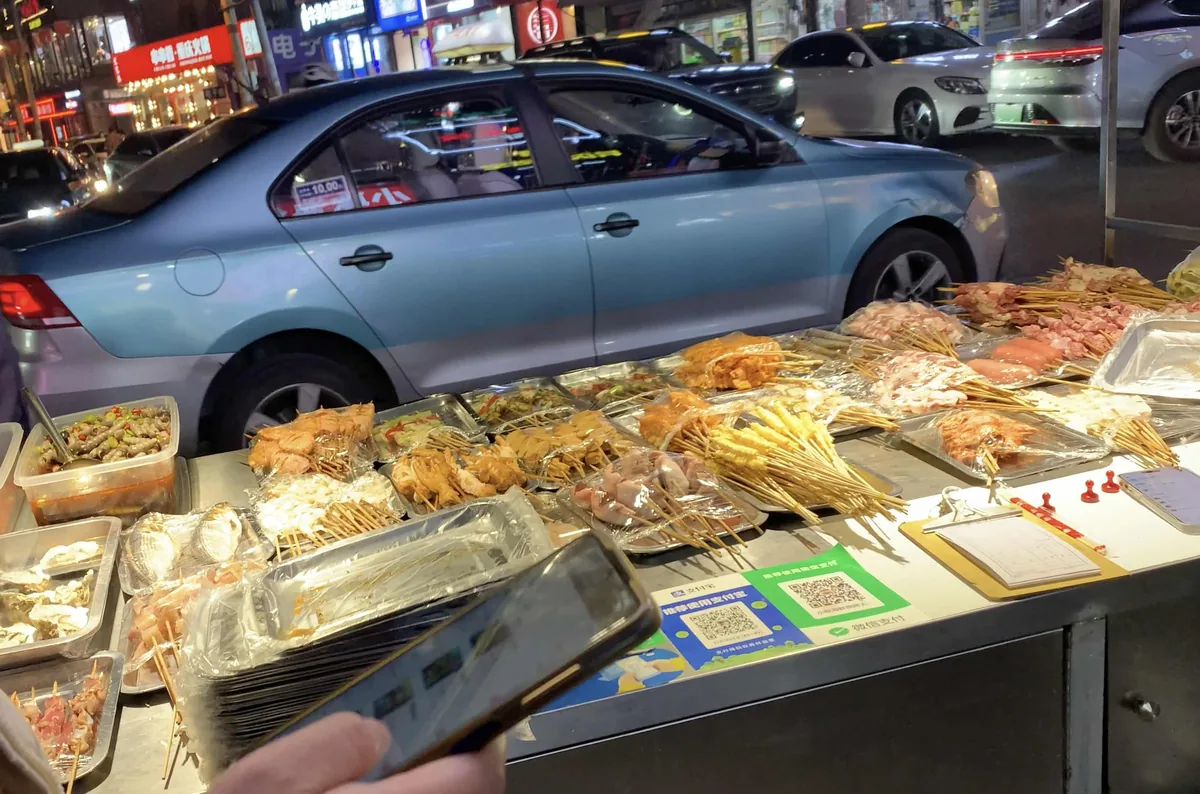
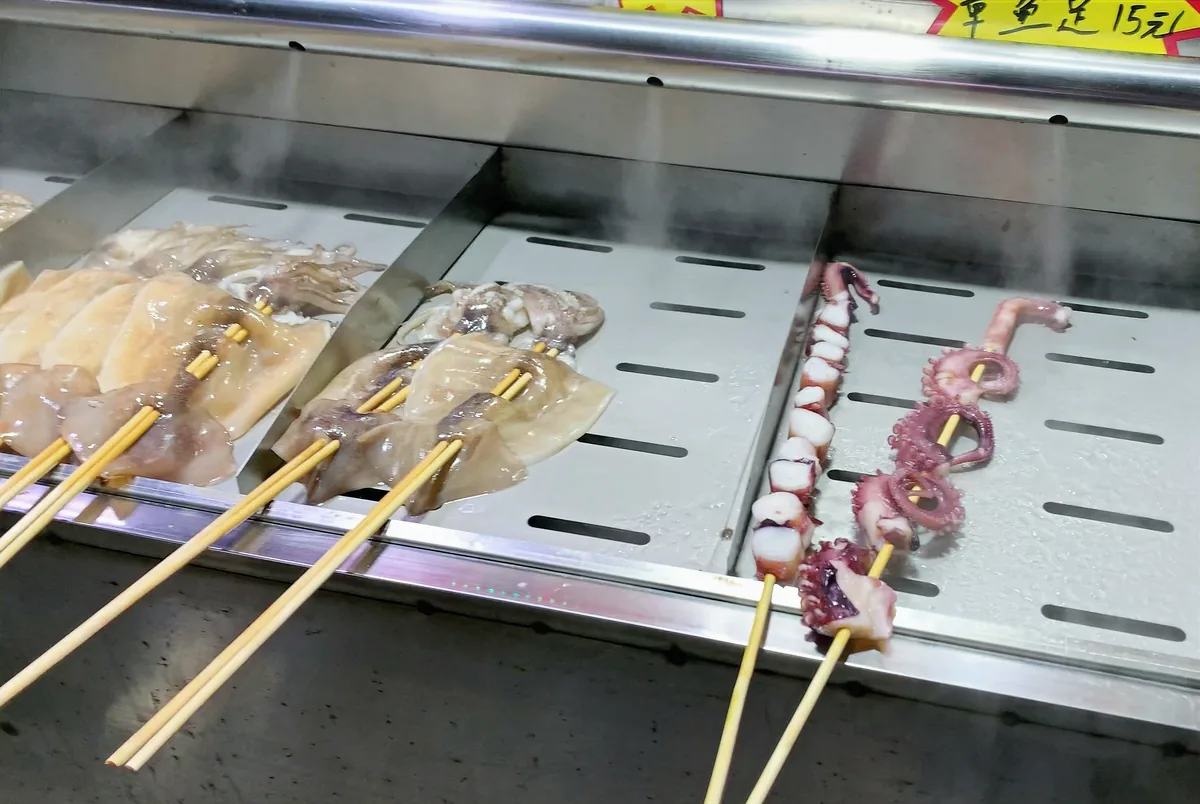
The northeast Chinese BBQ style, known as 东北烧烤 (dōngběi shāokǎo), is heavier on cumin, chili, and garlic than the more delicate styles you find further south. Everything gets dusted with 孜然 (zīrán, cumin) and 辣椒粉 (là jiāo fěn, chili powder). The combination with fresh seafood is extraordinary.
| Character | Pinyin | Meaning | Notes |
|---|---|---|---|
| 大排档 | dà pái dàng | outdoor BBQ / food stall | The venue itself |
| 烧烤 | shāokǎo | BBQ / grilled food | 烧 = burn, 烤 = roast |
| 串串 | chuàn chuàn | skewers | 串 = string/skewer; repeating it is casual |
| 鱿鱼 | yóu yú | squid | One of Dalian's specialities |
| 章鱼 | zhāng yú | octopus | 章 = chapter/seal, 鱼 = fish |
| 扇贝 | shàn bèi | scallop | 扇 = fan, 贝 = shell |
| 蛤蜊 | gé lí | clam | Very popular in Dalian |
| 孜然 | zī rán | cumin | The defining flavor of northeast BBQ |
| 辣椒粉 | là jiāo fěn | chili powder | 辣 = spicy, 椒 = pepper, 粉 = powder |
| 撸串 | lū chuàn | to eat skewers (casual) | A very colloquial verb: "grab some sticks" |
How the ordering works, and why your phone matters
At most Dalian 大排档, you don't flag down a waiter and recite your order in perfect Mandarin. Instead, you scan a QR code. The stall owner holds up their phone, or a laminated card is taped to the counter. You scan it with WeChat, and a menu appears.
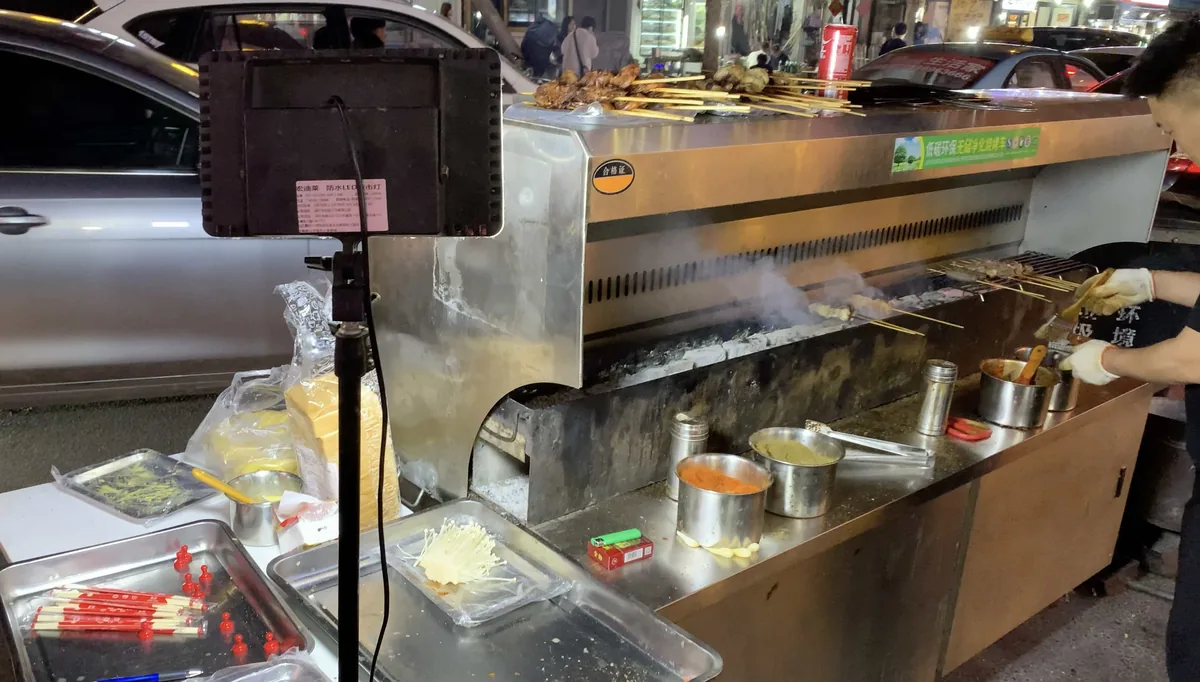
You tap the items you want, the quantity, any special requests (more cumin, less chili), and hit confirm. A notification goes to the cook. This is very 2020s China: even the most street-level vendor has a digital ordering system.
At smaller, older-school stalls you still walk up to the counter, point at the raw ingredients on display, and tell them what you want. This is when your Chinese actually earns you something: a better seat, more cumin, or just a big smile from the vendor.
The electric car detail
Here's something you notice quickly in Dalian, and across Chinese cities generally: the traffic around you is remarkably quiet. China has the world's largest fleet of electric vehicles, and by the mid-2020s a large portion of cars on the road, including taxis and delivery scooters, are electric. The result at a 大排档 table is that you eat surrounded by cars, but you don't smell petrol. You smell cumin and seafood. It's a genuinely surprising sensory experience.
电动车 (diàn dòng chē): electric vehicle (general term)
新能源汽车 (xīn néng yuán qì chē): new energy vehicle (official term, NEV)
充电 (chōng diàn): to charge (a battery)
电池 (diàn chí): battery
You'll see 充电桩 (chōng diàn zhuāng, charging pile/station) everywhere in Chinese cities.
A real conversation at the stall
Here's how a typical exchange might go when you walk up to a Dalian BBQ stall and order directly. Notice how short and direct Chinese food ordering language is direct. No elaborate politeness needed.
The atmosphere, and why it matters for learning
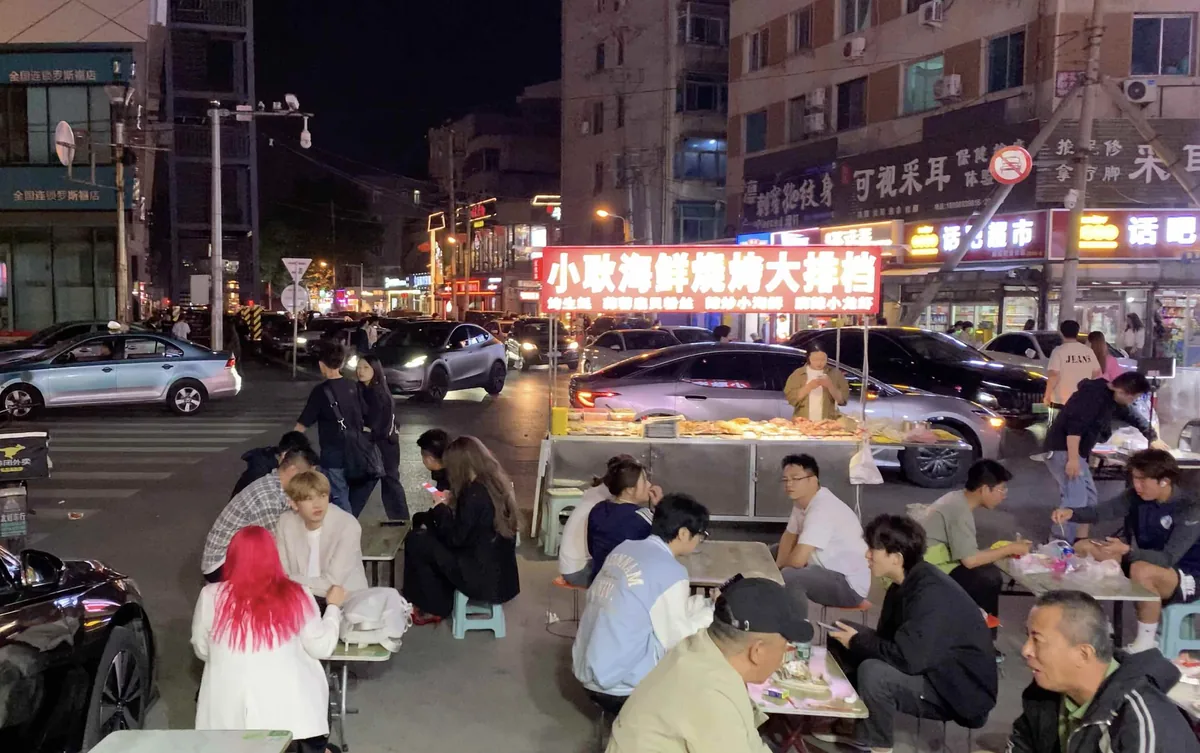
There is a reason language teachers talk about immersion. Sitting at a 大排档, low to the ground, surrounded by noise and smoke, with the vendor looking at you expectantly, you need to say something. That pressure, mild as it is, activates the language in a way that classroom study doesn't.
The vocabulary here isn't complicated. You don't need HSK 5 to order ten squid skewers and a cold beer. But you do need to actually say it, and say it confidently, and understand the casual reply that comes back. That's the gap between knowing Chinese and using Chinese. Our Mandarin for Travel track is built around closing exactly that gap. A Dalian BBQ street is one of the best places in the world to close it.
What to take away from this
The Dalian BBQ is a microcosm of modern China: street food culture that's been around for generations, now running on smartphone payments and electric vehicles, still served on plastic stools between passing cars. The combination shouldn't work, but it absolutely does.
From a language perspective, every visit to a 大排档 practices the same core skills: numbers, measure words, food vocabulary, and the short, direct sentences that make up most real-life Chinese conversation. If you can confidently order, ask about prices, request adjustments, and understand the vendor's reply, you've covered a significant slice of Travel Chinese.
1. 来十串鱿鱼。(Lái shí chuàn yóuyú.): Ten squid skewers.
2. 多放孜然,少放辣。(Duō fàng zīrán, shǎo fàng là.): More cumin, less chili.
3. 今天有什么新鲜的?(Jīntiān yǒu shénme xīnxiān de?): What's fresh today?
4. 能扫码吗?(Néng sǎo mǎ ma?): Can I pay by QR?
5. 买单!(Mǎi dān!): Bill please!